
How much does a babysitter cost? Everything you need to know about babysitting costs in the Netherlands, from teenage sitters to professional nannies. We’ll break down the average hourly rates, how much to pay based on age, experience, and location, and how extra tasks like cooking or caring for multiple children can impact the rate. With real-life calculation examples, a table of minimum wages, and helpful tips to help you decide on a fair babysitter salary.
Wondering what a babysitter costs in the Netherlands in 2026? Whether you’re hiring a teenager for the occasional evening or looking for a professional nanny, rates vary widely depending on age, experience, and responsibilities. In this guide you’ll find average hourly rates, real-world examples, and tips for setting a fair and reasonable babysitting rate.
According to internal Sitly data, the average hourly rate for a babysitter in 2026 is €10.10. This figure typically applies to teenagers and students providing informal childcare. That said, rates can vary considerably, from less than €6.00 to more than €12.00 per hour, depending on age, experience, and the tasks involved.
What is the average babysitting rate in 2026?
The type of babysitter you hire makes a big difference:
- A professional nanny will generally charge a higher rate.
- A 16-year-old student doing the occasional evening of babysitting will often ask for significantly less.
According to Nibud (National Institute for Family Finance Information), babysitters aged 15 to 18 earn on average between €4.50 and €7.50 per hour, based on the minimum youth wage. You are not legally required to pay this minimum wage for occasional babysitting, but it does provide a useful reference point for what is considered reasonable.
As of 1 July 2026, the following minimum hourly wages apply in the Netherlands:
| Babysitter’s age | Minimum hourly wage |
|---|---|
| 15 years | €4.50 |
| 16 years | €5.17 |
| 17 years | €5.92 |
| 18 years | €7.50 |
| 19 years | €8.99 |
| 20 years | €11.99 |
| 21 years and older | €14.99 |
Babysitting rate for a 15-year-old
Many parents choose a 15-year-old babysitter when they want to go out for the occasional evening or need a few hours of extra help. Rates for babysitters of this age tend to be a little lower than for older sitters. This is because younger babysitters often have less work experience and usually carry out simpler tasks, such as keeping an eye on children while they sleep or playing with them after school.
According to the minimum youth wage, the minimum hourly rate for a 15-year-old in 2026 is around €4.50per hour. In practice, many 15-year-old babysitters charge slightly more, particularly if they already have babysitting experience or are responsible for more than one child. Generally, the babysitting rate for a 15-year-old tends to fall between €4.50 and €6.00 per hour. Rates can vary depending on a number of factors, such as the region, the number of children, and the tasks expected. If a babysitter is also helping with light household tasks or preparing dinner, a slightly higher rate may be reasonable.
What does an 18-year-old babysitter cost?
An 18-year-old babysitter is an adult and often has plenty of experience with childcare. At this age, many babysitters are fully independent and capable of taking responsibility in more complex situations, such as looking after several children at once, helping with homework, or handling unexpected circumstances.
As of 1 January 2026, the statutory minimum hourly wage for an 18-year-old is €7.50 per hour. You are not legally required to pay this minimum wage for occasional babysitting, but it does provide a useful reference point for what is considered reasonable.
In practice, rates for an 18-year-old babysitter are often slightly higher. On average, 18-year-old babysitters charge between €7.50 and €11.00 per hour. This can vary depending on the situation. If the babysitter is caring for multiple children, preparing meals, or is responsible for a longer period of time, the hourly rate may be higher. Rates also tend to be higher in larger cities such as Amsterdam or Utrecht than in smaller towns.
Hourly rate or fixed fee: what is standard?
Most babysitters are paid by the hour, particularly for occasional or flexible childcare. This is the fairest way to align payment with time and effort.
That said, there are situations where a fixed amount per session is agreed, for example for a regular weekly evening, when the children are already in bed and little active care is needed.
Things to consider when choosing between an hourly rate and a fixed fee:
- An hourly rate is fairer for flexible arrangements: if hours vary, tasks may change, or you need last-minute childcare. You pay exactly for the time the babysitter is present, including unexpected situations or extra work.
- A fixed fee works well for regular arrangements: for example, every Saturday evening from 7pm to 11pm. When expectations are clear and both parties know in advance what is involved, this is often simpler for both administration and budgeting.
What to consider when agreeing a fixed babysitting rate
If you agree on a fixed amount per babysitting session, it’s important to be clear upfront about what is included. Think about:
- The number of children being cared for
- Whether any household tasks are involved
- Any travel time or transport costs
Make sure the fixed amount doesn’t end up too low if the work takes more time or effort than expected. Even with a fixed rate, you can choose to give a small bonus or additional payment if the babysitter carries out unexpected tasks or stays longer than planned.
Example: A babysitter agrees a fixed fee of €40.00 for a 5-hour evening where the children are already asleep and there are no extra tasks. If she needs to arrive earlier, stay later, or prepare dinner, it’s reasonable to agree an additional hourly rate or adjust the total accordingly.
How experience and training affect babysitting rates
A babysitter’s knowledge and experience have a significant impact on how much they earn and what they feel is reasonable to charge. It’s not just about age:
- A 20-year-old student with a qualification in childcare or early years education will naturally charge a higher rate than a first-time babysitter.
- But a 15-year-old with plenty of babysitting experience is also perfectly entitled to charge more than the minimum wage.
Generally speaking, the more experience or qualifications a babysitter has, the higher the expected hourly rate. As a parent, it comes down to a personal choice:
- Are you happy to hire someone with little experience, and would you rather pay a lower rate while they learn?
- Or do you place a high value on experience and reliability, and are you willing to pay more for that?
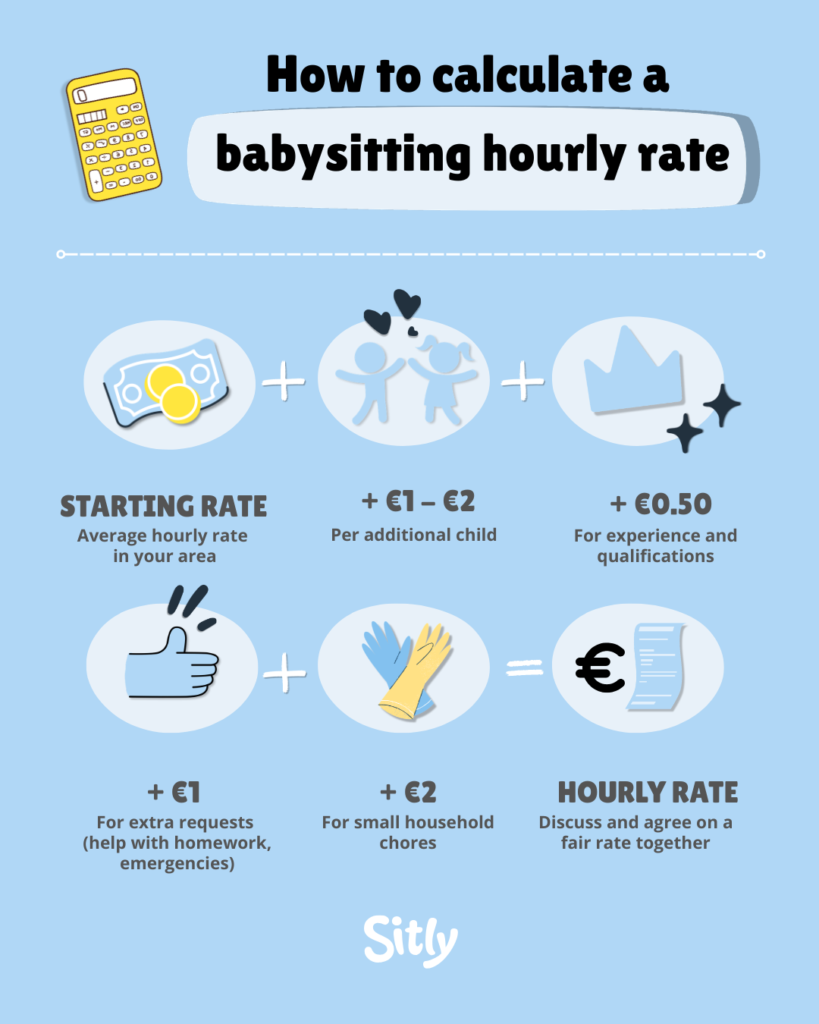
There’s no right or wrong answer. What matters is that you both arrive at a rate that feels fair for everyone involved. Want a guideline to help you work out a suitable babysitting rate? Take a look at the infographic below.
Use the Sitly calculator to see babysitting rates in your area straight away. Enter your location, the tasks involved, and the number of children, and you’ll instantly see the average rate.
A babysitter’s hourly rate depends not only on age and experience, but also on the tasks you expect them to carry out.
What exactly does your babysitter do?
If you ask your babysitter to take on extra responsibilities, it’s only fair that a higher rate reflects that.
For example:
- Are they looking after more than one child at a time? A higher rate is reasonable.
- Does your child need a lot of attention or specific care? That also justifies a higher amount.
Example: Babysitter (18 years old) – 3 Children + Dinner Prep
Background. Sarah is 18 years old and has a lot of babysitting experience. She is studying to become a primary school teacher and holds a child first aid certificate.
Every week she babysits for a family with three children aged 8, 5, and 3. She arrives at 2pm, picks the children up, and brings them all home for a snack and some playtime. When the weather is nice, they head outside. The parents also really appreciate that she prepares dinner, so the family can eat together when they get home at around 5:30pm.
What’s a Fair Rate for Sarah? Breakdown of her rate:
€7.50/hour — Minimum wage for an 18-year-old
+€3.00/hour — For caring for two additional children
+€1.00/hour — For experience and first aid certificate = €11.50/hour
For a babysitting session of 3.5 hours, the total comes to:
€11.50 × 3.5 = €40.25
Babysitting babies vs. older children
The age of your children plays a big role in determining a fair rate. Looking after a baby or toddler is intensive and requires constant attention. The babysitter needs to stay alert and actively engaged the whole time. This justifies a higher hourly rate.
With children of around six and older, care is often less intensive. They can feed themselves, use the bathroom independently, and keep themselves entertained for a while. This reduces the workload for the babysitter, which can also be reflected in the rate. In short: the younger and more dependent the children are, the more care is needed — and the higher the babysitting rate can reasonably be.
Household tasks and light cleaning
If you’d like your babysitter to help with household chores on top of childcare, it’s only fair to pay them a higher rate.
Examples of tasks that justify extra pay:
- Hoovering the living room
- Loading or unloading the dishwasher
- Folding laundry
- Washing up
- Preparing dinner
Bear in mind that a cleaner in the Netherlands earns on average between €14 and €16 per hour. So if your babysitter is also helping around the house, it’s perfectly reasonable to pay extra for that.
Evening babysitting vs. daytime babysitting
Do you only need someone for the evening hours, or does your babysitter need to pick the children up from school and look after them for the whole afternoon? The babysitting rate may differ depending on this. During the day, babysitters are generally more actively involved with the children. In the evening, the children go to bed and there is usually less work involved.
That said, there can be big differences when it comes to evening babysitting:
- The children are already in bed and sleep through the night — the babysitter is present but not very active. In this case, many parents and babysitters opt for a slightly lower rate than when active care is needed. The babysitter is always responsible though, even when the children are asleep.
- The babysitter still needs to put the children to bed — think of giving dinner, bath time, reading a story, and tucking them in. This requires active involvement and justifies a higher rate.
- The children wake up frequently during the night — if you know in advance that the children regularly wake up and the babysitter needs to stay alert, a higher rate is fair and logical.
It’s a good idea to discuss these kinds of expectations clearly in advance, so you can agree on a rate that truly reflects what is being asked.
Also agree on how you’ll handle getting home safely at night. Will you give the babysitter a lift home? Will you cover a taxi? Your babysitter’s safety is a shared responsibility.
Example: 16-year-old babysitter, 2 children, evening babysittingPrep
Background. Lieke is a 16-year-old secondary school student with more than two years of babysitting experience with her younger brother and cousins.
In her new babysitting family, she occasionally looks after two children on weekend evenings. When she arrives at 7:30pm, the children are already asleep. She stays until 11:30pm, after which the parents drive her home. She is always offered something to drink and a snack, and the parents have asked her to unload the dishwasher during her session.
Whatr is a reasonable rate for Lieke?
- €5.17/hour — Minimum wage for a 16-year-old
- +€1.00/hour — For looking after a second child = €6.17/hour
Total payment: €6.07 × 4 hours = €24.68
Lieke is very happy with this arrangement: it’s relaxed, the parents are clear about expectations, and it feels fair for both parties.
Last-minute or on-call babysitters
Do you unexpectedly need a babysitter? That flexibility comes at a price. Asking your babysitter at short notice, especially during the day or on a tight timeline, may mean they have to cancel other plans or rearrange their day. Especially if they’re a student, that requires real flexibility.
In these situations, it’s respectful to offer a slightly higher hourly rate. Quick availability is convenient for you, and it deserves fair recognition.
Babysitting rates by region
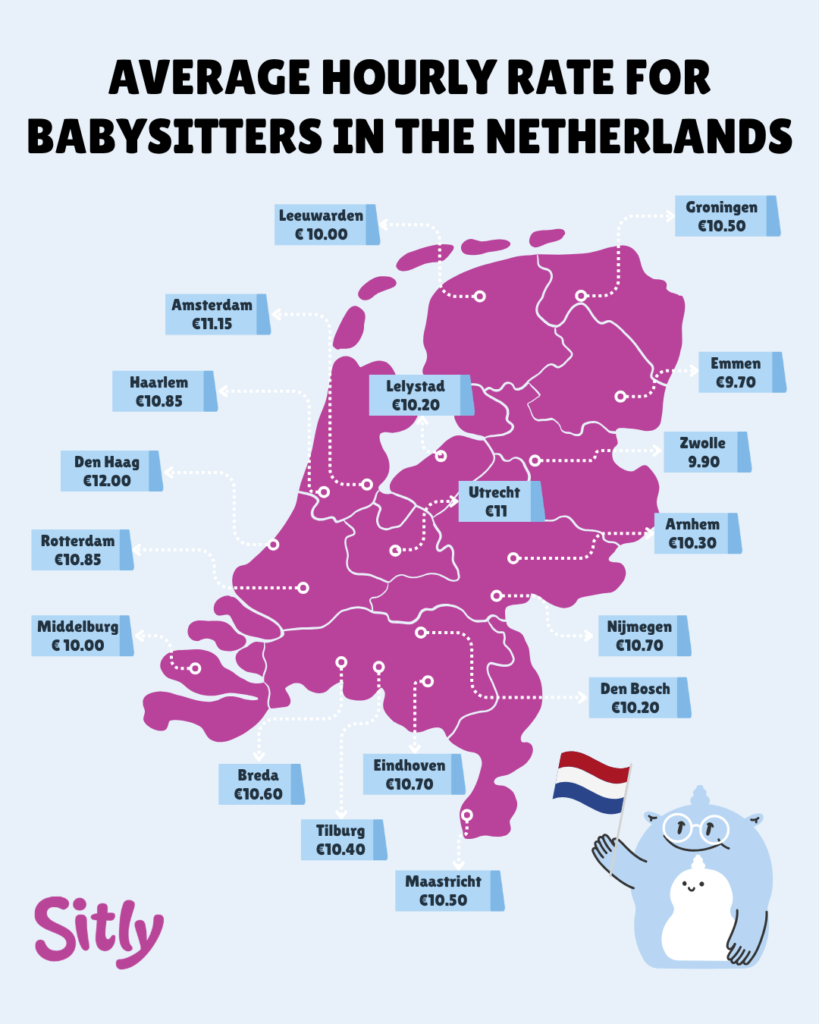
As you’ve seen in the examples above, babysitters in Amsterdam tend to earn more than those in Emmen:
- Amsterdam: average €11.15 per hour
- Emmen: average €9.70 per hour
That’s a difference of almost €1.50 per hour for comparable work.
Similarly, the average hourly rate for a babysitter in Rotterdam is around €0.95 higher than in Zwolle. Where you live definitely has an impact on how much you pay a babysitter.
Map of hourly babysitting rates in the largest cities
.
Babysitting rates: large cities vs. smaller towns
Babysitting rates in the Netherlands vary not only by region, but also significantly between large cities and rural areas. Based on the hourly rates babysitters list on their own Sitly profiles, the table below shows the average by age.
Average hourly rates: Top 15 cities vs. the rest of the Netherlands
| Babysitter’s age | Large cities (Top 15) | Smaller towns / rural areas |
|---|---|---|
| 14 years | ~ €4.50 | ~ €4.20 |
| 15 years | ~ €5.40 | ~ €5.10 |
| 16 years | ~ €6.00 | ~ €5.50 |
| 17 years | ~ €6.40 | ~ €5.80 |
| 18 years | ~ €7.20 | ~ €6.50 |
| 19 years | ~ €8.50 | ~ €7.00 |
| 20 years | ~ €10.00 | ~ €8.50 |
| 21 years and older / experienced babysitter | ~ €11–13+ | ~ €9.00–11 |
Source: These figures are based on the average hourly rates listed by babysitters aged 16 to 21 on their Sitly profiles.
The average difference between large cities and smaller towns is currently around €1.50 to €2.00 per hour — an amount that can add up significantly if you need regular childcare.
What does a registered childminder cost?
If you’re looking for regular daytime childcare and like the idea of your child being looked after outside your own home, a registered childminder is a good option.
To be eligible for childcare benefit, the childminder must meet a number of legal requirements:
- Be registered with an approved childminder agency
- Have completed at least an MBO level 2 qualification
- Provide care at a location that meets official safety standards
If your childminder meets these requirements, you may be able to apply for childcare benefit. Please note: you must apply within 3 months of the month in which care began.
So, what do you pay a babysitter?
There’s no fixed amount that applies to every situation. The right hourly rate depends on a number of factors, such as:
- The babysitter’s age, experience, and any certificates they hold
- The number of children and their ages
- Whether any additional tasks are expected, such as cooking or light household chores
- Whether care takes place during the day or in the evening
- Your location or region
- And of course: your own budget
Ultimately, it’s about finding the right balance between fair pay for the babysitter and affordable, reliable care for your family. The most important thing is open communication. Talk through expectations, responsibilities, and the rate together. That way, you’ll reach an agreement that feels right for both parties.
Table of contents


FAQS

A babysitter earns on average between €8 and €12 per hour, depending on age, experience and location. In large cities such as Amsterdam, Rotterdam and Utrecht, the average is closer to €11–€13 per hour, while in smaller towns the rate is often around €9 per hour.
An experienced babysitter earns on average between €12 and €15 per hour. Babysitters with a first aid certificate, childcare training or experience with babies or multiple children can charge more, sometimes up to €17 per hour in urban areas.
For a full day of babysitting you pay on average between €60 and €100, depending on the length of the day and the number of children. For longer days or additional household tasks, the fee can rise to €120 per day.
A babysitter who stays overnight costs on average between €40 and €70 per night when the children are mostly sleeping. When active care or feeding is required, the price rises to €10–€15 per hour for the hours worked.


Trusted sitters, right around the corner
Need a little help? Sitly connects you with experienced babysitters in your area. Whether you need occasional or regular care, finding the right babysitter is super easy. Browse profiles, read reviews, and reach out to your favorites right away.

Related Articles

When is a baby old enough for a babysitter?
Wondering when your baby is old enough for a babysitter? While there’s no single “right” age, short and gradual separations are possible even in the early months when the babysitter is experienced and routines are respected.
Calculate Your Babysitter’s Rate with the Sitly Calculator
Find out how much to pay a babysitter in your area. Sitly’s Babysitter Rate Calculator shows average rates across the Netherlands and helps you estimate a fair hourly wage based on your city, number of children, and any extra duties. Get a clear and personalized indication of what families and babysitters usually agree on.

10 Ways to Help Your Child Overcome Fear of Monsters at Bedtime
If your child is afraid of monsters at bedtime, you’re not alone. Many kids aged 3 to 6 struggle with nighttime fears fueled by imagination and change. In this article, you’ll learn why these fears happen, how to validate them, and 10 simple, creative ways to help your child feel safe and sleep peacefully. From using nightlights and comforting routines to anti-monster sprays, magic spells, and stuffed animal bodyguards—each idea is designed to reduce anxiety and empower your child at night.